From Suno to Spotify:
Make Something Worth Hearing
Somewhere right now, someone is turning the worst week of their life into a three minute song, hoping a stranger hears it and feels a little less alone. That impulse is older than every instrument ever built. It is also the one thing a generator cannot fake, and the one thing that makes this entire guide worth reading.
This is the last part of the Before You Master series, and it pulls the rest together. The earlier articles took the small, specific problems one at a time: why AI tracks sound off, what changed between Suno versions, how to prompt, whether to master, how to remove a click or a ring. This one is about the whole road, from a raw Suno idea to a release worth someone's time, and about why that road matters more today than it did a year ago.
Slop is real. It is also not the whole story.
Let us be honest about the thing everyone keeps dancing around. AI slop is real, and it stings the people who make music the hard way. When the feeds fill up with feeling free, mass produced tracks, it cheapens the thing working musicians bleed for, and the resentment that follows is earned. We are not going to pretend otherwise.
But AI art and traditional art do not cancel each other out. This is an awkward transition, not a war, and ten years from now the whole panic will read as a strange and slightly funny memory. The tools will be everywhere and nobody will flinch. What will still matter then is the same thing that matters now: whether a song carries anything.
Right now there are roughly four kinds of people making music with these tools. There is the hobbyist, and there are millions of them, making a funny song about a coworker, dropping it in a group chat, getting a laugh. That is a completely good use of the technology, and it is not what this article is about. They are not chasing playlists, and they should not.
There is the spammer, pushing ten albums a week of pulse free elevator music into every feed. The resentment aimed at this is the earned kind, because it steals oxygen and credibility from people doing real work. We are not defending it, and as the next section shows, the platforms are not defending it either.
Then there are the two kinds of people this is written for. The producer who treats AI as one instrument inside a larger process. And the demo maker who uses AI to sketch a song, then plays it, records it, and produces it for real. Add to them anyone whose music carries their own pain, feeling, or message, whatever tools they happen to reach for. If that is you, keep reading. If it is not, the honest truth is that nothing here will help you.
This guide is not for everyone, and that is the point. If you are shipping ten tracks a week, nothing here will move the needle for you, and the platforms are about to make that path a great deal harder anyway.
The slop era is ending
For a while it looked like the flood would just keep rising. It is not going to. The streaming platforms have started clearing the slop off their shelves, and they are doing it at a scale that is easy to underestimate.
Across 2025, Spotify removed somewhere around 75 million spam, fraud, and low quality tracks. Its spam filter now stops recommending uploaders who mass upload, duplicate, or stuff their metadata with search tricks, which means the exact behaviour the spammer relies on is now the thing that buries them. In April 2026 Spotify added AI Credits, a way for artists to disclose how AI was used on a track, shown in the song's credits on mobile. Apple Music has been phasing in its own transparency tags, and Deezer runs in house detection and pays reduced or zero royalties on fully AI tracks.
Read that the right way and it is not bad news. It is the best news this series has had. The world just started rewarding the exact thing these ten articles have been about. Quality is no longer only a matter of taste. It is now a survival strategy. The mass uploaders are being filtered out by design, and the lane that opens up is for people who make fewer, better things.
We do not cheat the detectors, and neither should you
There is already a shady little industry selling the opposite of this. Pay a fee, run your track through a tool, and it will strip the AI fingerprints so you slip past inspection. That is the exact inverse of everything we believe, so let us be blunt about where we stand.
MasterForge and our tools do not touch, strip, or alter AI detection metadata. We do not try to hide that a track was made with AI. We remove artifacts because they sound bad, not to fool anyone. Disclosure is voluntary and carries no penalty, so being honest about your tools costs you nothing and is simply the right thing to do.
The thing that gets a track buried is not honesty. It is slop and spam. So the whole strategy fits in one line: be honest, and be good.
Cleaning a track and disguising a track are two different jobs. We only do the first one. If a tool's pitch is "beat the detector," it is not a mastering tool, it is a costume.
Build it before you release it
If you are going to put something out, build it well first, because the platforms are now sorting for exactly that. A song needs a spine before it needs a sound, so the order matters.
Start with something to say, then write it. Use AI to help the words land, to get rhythm, rhyme, and meaning hitting at the same time, rather than to write them out of nothing. We covered how Suno actually reads your input in Prompt Like a Producer, and that is where the real control lives.
Keep the arrangement lean. Three instruments beat five, not as a compromise but as the smart play, because Suno has real production bottlenecks and the fewer voices it has to render, the cleaner the result. Why Arrangement Matters goes through the reasons in full.
Then iterate. Do not ship take one. The generic output is a starting point, not a master. Find your own voice in it, blend genres, and push past the first thing the model hands you.
And use it as inspiration, not as the answer. The newer use as inspiration workflow is genuinely powerful. Feed in a track from a different genre, say a tight rap rhythm, as the seed for your own pop song, and you can land something with a pocket and a momentum that a plain text prompt would never have given you. The point underneath all of it is simple. The work happens before the track is done. The people who skip this part are precisely the ones now being filtered out.
The demo path
There is a second way to use these tools that deserves saying out loud, because it is already part of how working producers operate: AI as a demo tool. You sketch the idea in Suno, get the shape of the song down fast, and then play it, record it, and produce it for real.
This is not fringe and it is not new. Producers have always demoed, and AI is just a faster sketchpad. It is already inside the major DAWs and that will only grow. So the honest framing is not AI versus real music. It is that AI has become one more tool on the bench, and the craft is in how you use it.
Prepare it before you polish it
Because of how Suno generates audio, every track arrives with artifacts baked in. Noise that should not be there, and sometimes gaps where something should be. These are production bottlenecks, not user error, and The Science Behind the Artifacts breaks down exactly what they are.
Mastering is the final polish. But you do not polish something that is still dirty. First it gets prepared. Preparation is an automatic pass that scores thirteen separate defect types and fixes the ones that cross a threshold, before the master ever starts. It is still in development and not out yet, so treat what follows as a look at where the pipeline is going, not a button you can press today.
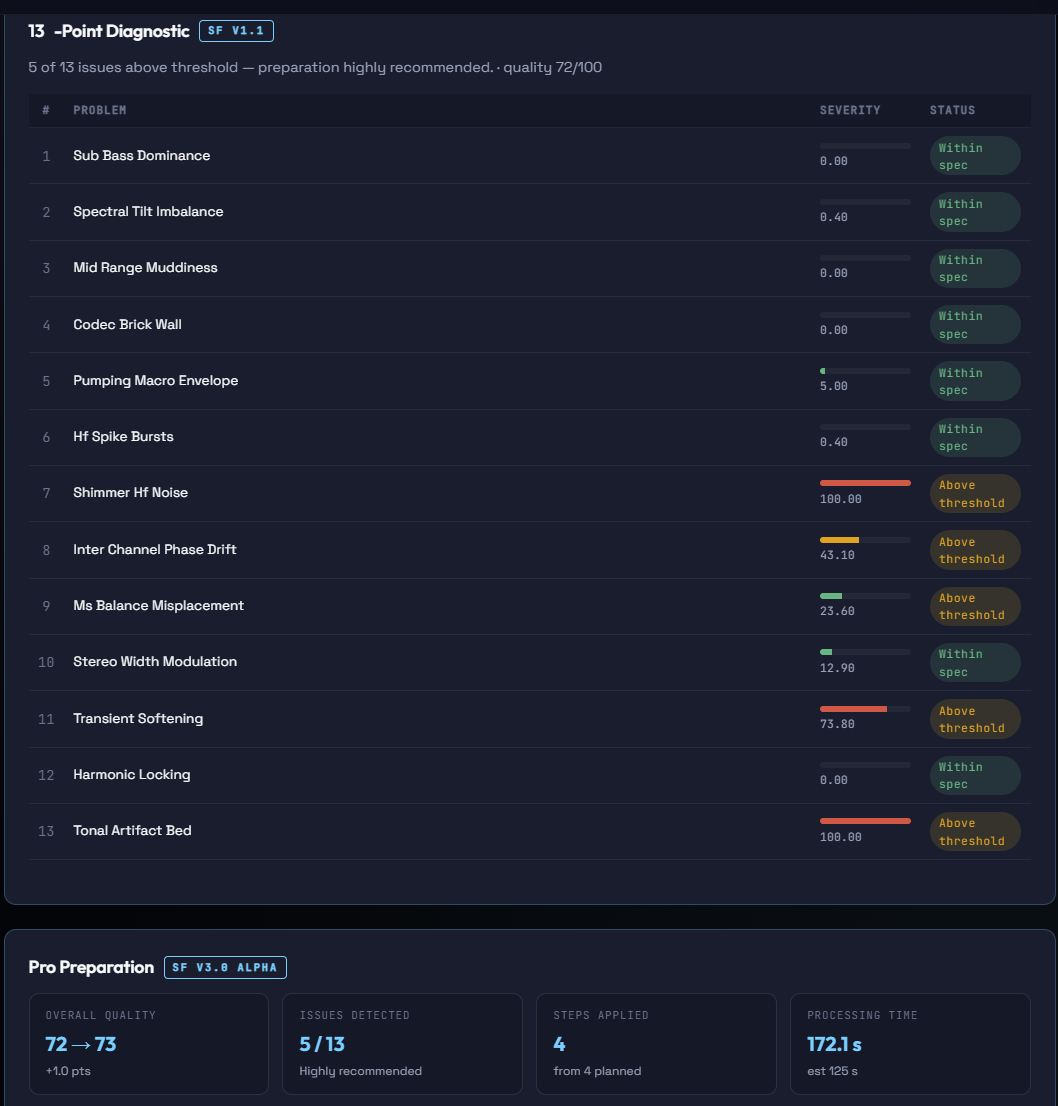
One of those thirteen fixes is de-tone, and it is worth explaining on its own, because it solves a problem nothing else in the chain can.
De-tone: removing the whole whistle, not one note
Suno bakes in a tonal artifact bed: a faint, steady whistle plus a comb of static tones, spread across roughly two to six kilohertz and sitting mostly in the side channel. It reads as a thin whine threaded behind everything, and it is a large part of why an AI track can feel tiring and flat.
The important thing is that this is not one frequency. It is a broad bed, and that distinction is the whole reason de-tone exists. It is worth comparing to the tool from the previous article. Surgical Cleanup is manual and narrow: you hunt one offending frequency by ear and drop a deep, high Q notch on it, a scalpel on a single tone. De-tone is the opposite kind of tool. The artifact is a whole bed smeared across a wide band, so a notch cannot touch it. Instead, de-tone estimates that bed and subtracts it across the range. It detects the artifact itself, with no frequencies for you to enter, and it protects the air above roughly six to nine kilohertz structurally, so cymbals, sparkle, and brightness come through untouched.
Two different problems, two different tools. A narrow notch on one side, a broadband bed subtraction on the other.
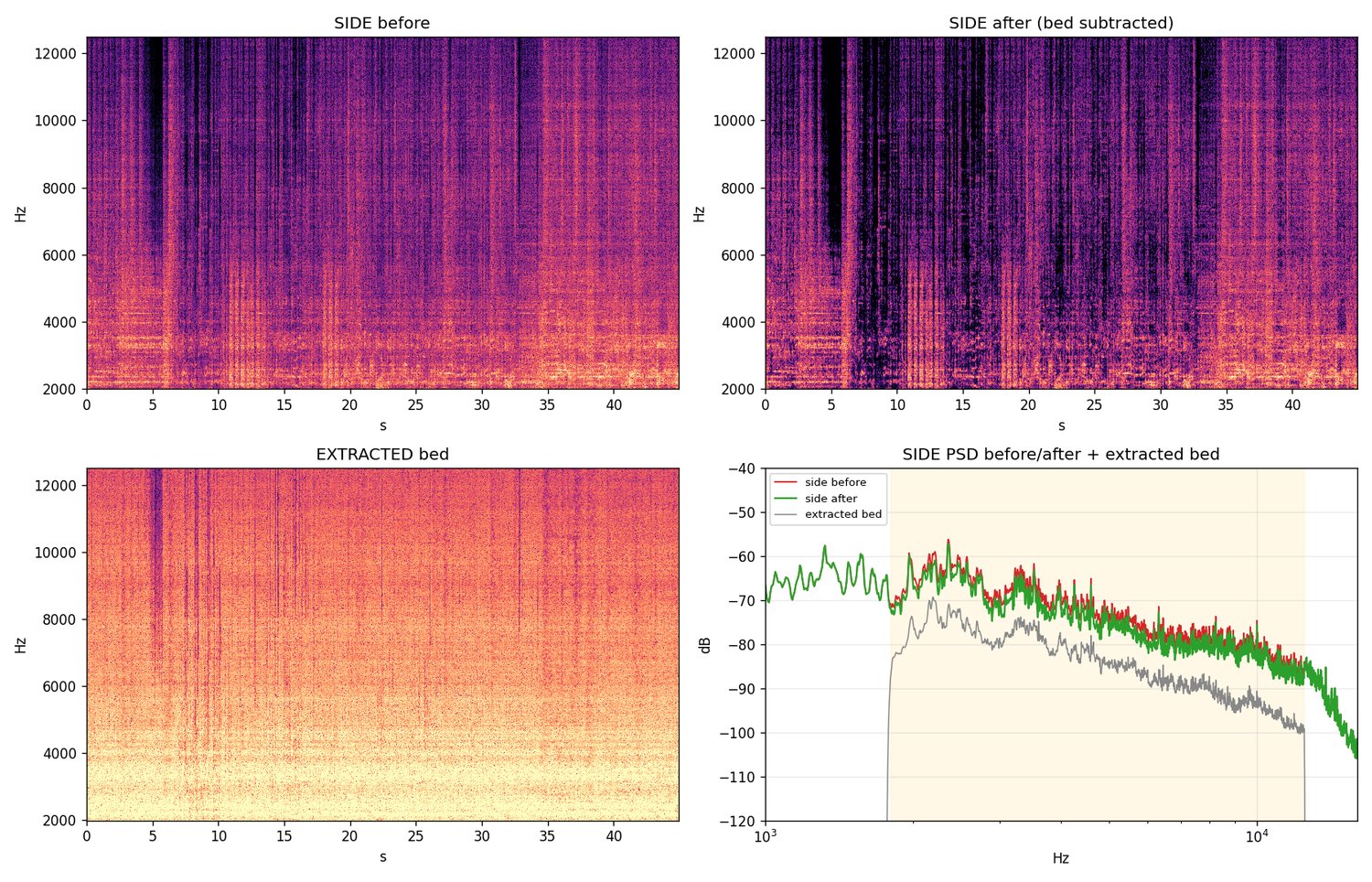
The result is the part you actually hear. The whine drops, the track opens up and gains depth, and the real high end stays bright. Measured on a real metal track, the side channel bed came down by about five to six decibels while the air between eight and twelve kilohertz barely moved at all.
The whistle bed is one of those defects you never consciously name, but it is exactly what makes a track tiring over a few minutes, and it gets louder the better the playback gets. Take the bed out and keep the air, and the same song suddenly sounds finished.
Mastering: the final voice
Once the track is prepared, it gets mastered, and this is where it earns its final shape and its final sound. It is the difference between a file and a record.
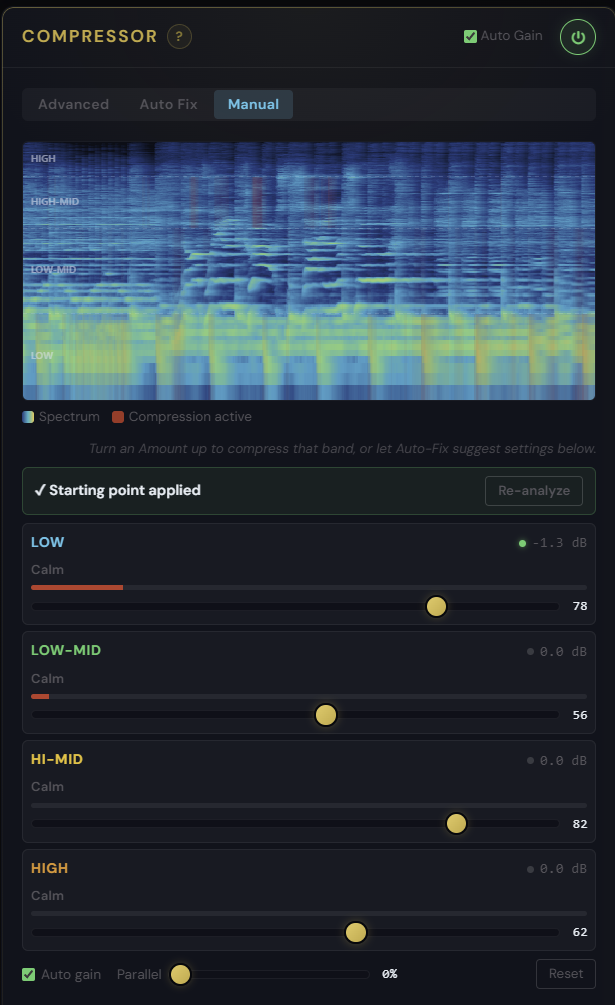
The easy, one click masters are fine for plenty of cases. But the best result comes from professional grade tools, the kind with real per band control, the surgical fixes, and proper metering. The catch, historically, was that those tools meant relearning an entire DAW. That is the whole point of Pro Master. The control is there, the metering is there, and you do not have to go back to engineering school to use it.
And mastering has to know the song. There is no single magic chain that works on everything. What a sparse ballad needs and what a wall of techno needs are not the same, which is the lesson we pulled out of mastering thirteen different tracks in 13 Tracks, 13 Recipes. If you are still on the fence about whether AI audio needs this step at all, Does AI Music Need Mastering? walks through the why.
Getting it heard
Distribution is the simple part, so we will keep it short. You get onto Spotify, Apple, and the rest through a distributor. The common, reliable ones are DistroKid, TuneCore, and CD Baby. They handle the upload and the metadata, including the optional AI disclosure field. Pick one, ship the track, done.
The part to watch is the scams. There is now a whole ecosystem of playlist scams and AI radio scams, selling pay to play placements, bot streams, and fake curators. They burn your money, build nothing real, and can get your account demonetised, because the platforms now actively penalise artificial streaming. If someone guarantees you placement or a stream count for a fee, they are selling you the exact behaviour Spotify's spam filter was built to catch.
The real path is slow and unglamorous. A good song, honest distribution, and patience. There is no shortcut that is not also a trap.
What it is really for
Two honest things before the end. AI music still has a ceiling. It cannot do everything, and pretending it can is part of the slop problem in the first place. Mastering will not fix a bad song, and neither will preparation. If the writing is not there, no amount of polish will save it. Real craft takes real time, and the fast path is the slop path. And even when you do everything right, not everyone will respect it. That is fine.
One more honest note, about the demos. The before and after tracks scattered through this series were never made to be released. They exist to calibrate the tools. Making music can be its own end. Sometimes the whole value is in the making and the working through, and the song never needs another set of ears, and that is allowed. Nothing here says you have to share. It says only that if you choose to put something out, it deserves to carry what you put into it.
Which is the whole point, and where we started. This was never about streams turning into money. It is about this: your pain, run through these tools, made honestly, can become something a stranger finds themselves inside.
If AI music wants to raise its profile, the move is to stop making slop. Even if you cannot hear the difference yourself, most people who work with music hear it instantly, and it reads as amateur on contact. Bad production is bad production no matter how you spin it. So make fewer things. Make them well. Make something worth hearing.
Hear it on your own track
Step 1. Drop any AI track into the MasterForge Audio Analyzer for a free health score and a full artifact breakdown. No account needed.
Step 2. When you are ready to finish it properly, open it in Pro Master.